
Root Canal Procedure Or An Extraction?
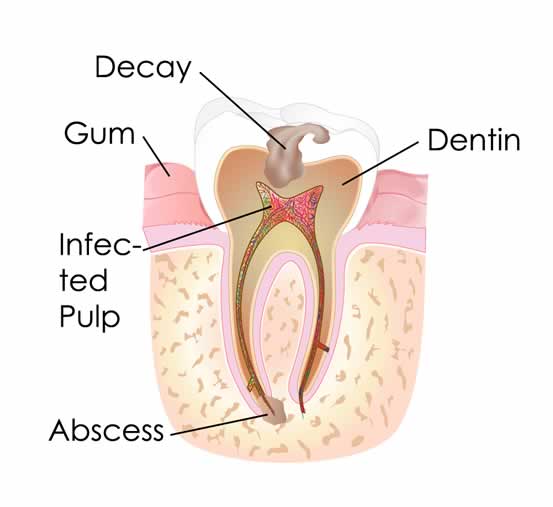
A look at the treatment options when the root canals of a tooth become infected.
It is almost certain that the most feared dental procedure, in the minds of many patients, is root canal treatment. This has become a standard ‘marker’ in films and books etc for the worst level of pain possible. There are probably good reasons for this. Certainly in days gone by, this procedure would have been significantly more ‘hit and miss’ with x-rays not yet being available to check for abscesses and inferior drills as well. Indeed, anaesthetics were probably more rudimentary back then and we suspect that most teeth affected in this way were simply extracted as it was the most straightforward option.
In today’s blog we are going to look at the often misunderstood root canal procedure and how it’s used to help prevent tooth extraction in these circumstances.
What happens when root canals become infected?
The soft pulp material contained in the root canals includes small blood vessels and the nerves of the tooth. Mostly, they do their job with no concern at all, protected by the tough enamel exterior of the tooth. The problems start to arise when this enamel is compromised and allows bacteria to enter into the inner part of the tooth known as the dentin layer.
It is at this stage that decay starts and cavities begin to form. If you have regular check ups at Bradley and Partners Dental & Implant Clinic, there is every chance that these cavities will still be in their early stages and can be restored using a small filling. Sometimes though, this may not be the case. Deep damage to the tooth, trauma or a failure to have regular check ups may lead to the bacteria entering the root canals. With the nerves being located here, this can, as you can imagine, be pretty painful indeed.
When you come to us with a toothache or severe sensitivity, this is one of the things that we look for using x-rays. If we find that the root canals are, indeed, infected, there are two choices available; either a root canal procedure or to have the tooth extracted.
Root canal procedure
More than occasionally, we see the look of fear on a patient’s face when we tell them that they need to have this treatment. Back in time, this would have been understandable for the reasons mentioned earlier. Modern dentistry has changed all this though and although it is an invasive procedure, the improvement in local anaesthetics and the advent of x-rays makes this treatment no more uncomfortable than most invasive dental treatments.
The first thing we do is to take an x-ray to see what is happening in the root canals and to check for any abscesses that need to be treated before treatment starts. Once this is ‘all clear’ we then inject the area with a powerful local anaesthetic to make the treatment as comfortable as possible.
Once the tooth is numbed, we may need to remove a small section from the top so that the root canals can be accessed. The infected pulp material is then removed, including the nerves. The hollow canals are then thoroughly cleaned to remove any bacteria and then filled using a special dental filling known as gutta percha. Once we are happy that the canals are now sealed, we usually add a crown to restore the tooth both in appearance and strength. The tooth will now, in effect, be a ‘dead’ tooth with no feeling and while it is strong, care should be taken when eating hard foods as you won’t be able to gauge how much you are biting down on things. We will discuss this with you at the treatment time.
The extraction option
Wouldn’t it be easier just to take the tooth out you might ask? This was certainly once a common practice but the advances in dentistry that allows us to carry out a root canal procedure in relative comfort means that preserving the tooth is a much better option. Extracting a tooth may be more straightforward but you will then be left with a gap in your teeth. This, in turn, leads to the surrounding teeth starting to move into that area and other nearby teeth to start to ‘shift’ too. Eventually, your teeth might become quite crooked. Even with teeth that are not visible to others, this can cause problems. Crooked teeth tend not to bite correctly and this can cause premature wearing and damage that will need to be treated down the line.
While it is certainly simpler to take a tooth out it is always best to restore it where possible. Of course, if a tooth is badly broken or decayed, with a poor prognosis, extraction is always an option and we can discuss the likes of dentures or implants to replace it.
So, if you are told by one of our Canterbury dentists that a root canal procedure is required, please don’t panic. We can almost guarantee it will be nowhere near as bad as you are anticipating. For those who are very anxious about the treatment, there is always the option of intravenous sedation and you can discuss this with the dentist who will explain what this entails.
If you would like to book an appointment to have a dental issue checked out, whether it is a toothache or just being unhappy with your smile, we are here to help you. To book your appointment with us, please call Bradley and Partners Dental & Implant Clinic today on 01227 463529.